When transitioning from bottle to breast it’s very challenging to lose the ability to physically see how much baby is getting. What once was a reassuring feed of 4, 6 or 8 oz is now being trusted on 5 or 10 minutes at the breast, hoping baby received the same amount.
But there are easy ways to ensure that baby is getting enough. Most importantly will be several observations during a feed, others you can observation during the day, and the rest you can observe from week to week.
During a Feed
Pain free: You can be reassured that baby has a good latch if there is no pain. Pain on the initial latch may sometimes occur, but as the feeding continues, the pain diminishes. This is because as the milk flow begins, baby is able to suck more of the breast tissue into their mouth.
A way to decrease this is to shape the nipple with your thumb and fingers around the outside of the areola and compress firmly to make a “sandwich”. This shape helps insert much of the breast tissue into baby’s mouth. Lean back and allow baby to fall onto the breast (don’t bring the breast to the baby).
Effective Drinking: There will be a good amount of drinking (not just nibbling) at the breast. This means you can see baby’s chin almost touch their chest and you can hear audible swallows. Baby’s drink in a “suck, suck, swallow” pattern so do not be alarmed if there is not drinking on EVERY suck, but if you are noticing regular and frequent drinking, this means baby is adequately removing milk.
Consistent latch: If baby maintains the latch and has good drinking, this means there is adequate milk transfer. Popping on and off the breast can occur when the flow slows down. You can apply compressions with the pads of your fingers, close to the chest wall (as to not distort the shape of the breast around baby’s mouth – causing baby to lose the latch) to increase milk flow and keep baby latched and drinking.
Switch Sides: If the flow has slowed down and compressions no longer keep baby drinking, you can switch sides. Some indicators that it may be time to switch sides because flow has slowed is if baby starts to become fussy, starts squirming, pops off the breast, or nipple pain arises (from baby starting to clench down).
A mother should switch sides as many times as she can to keep baby drinking from a fast flowing breast as long as a baby is cooperative at at the breast. Cooperation would look like a consistent latch, no pain, and has good drinking. This also helps to avoid baby falling asleep prematurely – before they had a full feeding. If multiple switches have occurred in one feeding, a baby may easily fall asleep and will not be interested in waking up for a top up. If this occurs you will not need to pump (unless you want to build a stash – but keep in mind building a stash will take MORE effort!).
NOTE: If the baby is uncooperative – fussy, not consistently latching, refusing the breast – do not force or keep baby at the breast. Take baby away from the breast, let dad hold them, put them over your shoulder, and get some fresh air for both of you. After a few minutes you can try breastfeeding again. If baby is still fussy and refuses the breast, it’s important to provide the method of feeding baby is most comfortable with and try breastfeeding again on the next feeding.
Satiation: Another way to determine if your baby is getting enough is by observing if they are satiated after a feed.
If baby is fussy/crying, pecking while on your chest, or bringing their hands to their mouth – This means baby is still hungry and needs to be fed on another side or offered a bottle. Do not try and distract with pacifiers, swaddles, or rocking to prolong or withhold a feeding.
During The Day
Feeding Cues: When babies are hungry, they will suck on their hands, lick their lips or stretch their hand(s) above their head. When you limit or avoid swaddles and pacifiers, parents are able to detect these hunger cues more quickly. Pacifiers and swaddles restrict these instincts and allow baby to settle for longer. Once baby moves from an early hunger cue to a late hunger cue, this is when they spit the pacifier out, break out of the swaddle (or try to) and begin crying. Crying is a late hunger cue, not an ideal one. Catching early hunger cues leads to more peaceful feedings, more efficient feedings, and more feedings on a daily basis which increases weight gain.
Feed On Demand: When babies are brought to the breast at every early feeding cue they have the potential to gain weight more than if they were to be given bottles on a schedule. Whether your baby is bottle fed, or breastfed, a baby should always be given more if they want it and given it when they want it. Feedings every 2-3 hours are the maximum if baby is sleeping a long time or is not showing any signs of hunger. It is not the average or the recommended; it is the limit!
Feedings may look longer or shorter than others. As long as there was effective drinking, there was no pain, and you switched sides multiple times, it is likely that baby had a good feed no matter when baby wakes up again. Many times babies will have a good feed, then have a 10 minute nap, and then wake to feed more. This is not an indication of a supply issue. This is normal infant behaviour.
There is no set time limit as to how long a baby will feed for or how many times they will feed in a day. Babies sleep may also follow the same pattern. Babies can be left to sleep and eat whenever their body needs it. Motherhood is more peaceful when the expectation for routine is dismantled.
TIP: If baby does not sleep during the day, allow baby to sleep at the breast. Babies are biologically designed to sleep at the breast. Additionally, it is crucial for babies development to get their adequate daytime sleep.
Breastfeeding was the first pacifier and it doesn’t need to be replaced; it can be embraced.
Jocelyn Frank
Weight Gain: In the first two weeks, many babies lose some of their weight after birth but reach their birth weight within 2-3 weeks of age. You can minimize this loss by keeping baby at the breast as much as possible, avoid pacifiers/swaddles, and keep guests that want to hold baby or do not support your breastfeeding journey to a minimum.
Babies will gain on average different weight depending on how old they are. As your baby grows they will gain less weight.
0-3 Months: 113-226 grams a week (16-21 grams/day).
4-6 Months: 85-142 grams a week (12-20 grams/day).
6-12 Months: 42-85 grams a week (7-12 grams/day).
Breastfed babies on average gain weight slower than formula-fed infants. Parents can also detect weight gain by simply looking at baby’s face and legs. They tend to easily fill out and get visibly bigger when weight gain is optimal.
Diaper Output: The general rule of thumb in a baby’s first week of life is that they will have as many wet diapers as they are days old. After the first week their pees and poos should be consistently six or more wet diapers and at least three large, soft, seedy, yellow stools a day.
Day 1-2: 1-2 wet diapers and 1-2 black or dark green stools (meconium). Colostrum helps to eliminate this meconium.
Day 3-5: 3-5 heavy wet diapers and at least 3 greenish, brown, or yellow stools.
Day 6-13: 6+ heavy wet diapers and at least 3 soft, seedy, and yellow stools.
6+ Weeks: 6+ heavy wet diapers but their stools may increase in size but decrease in frequency.
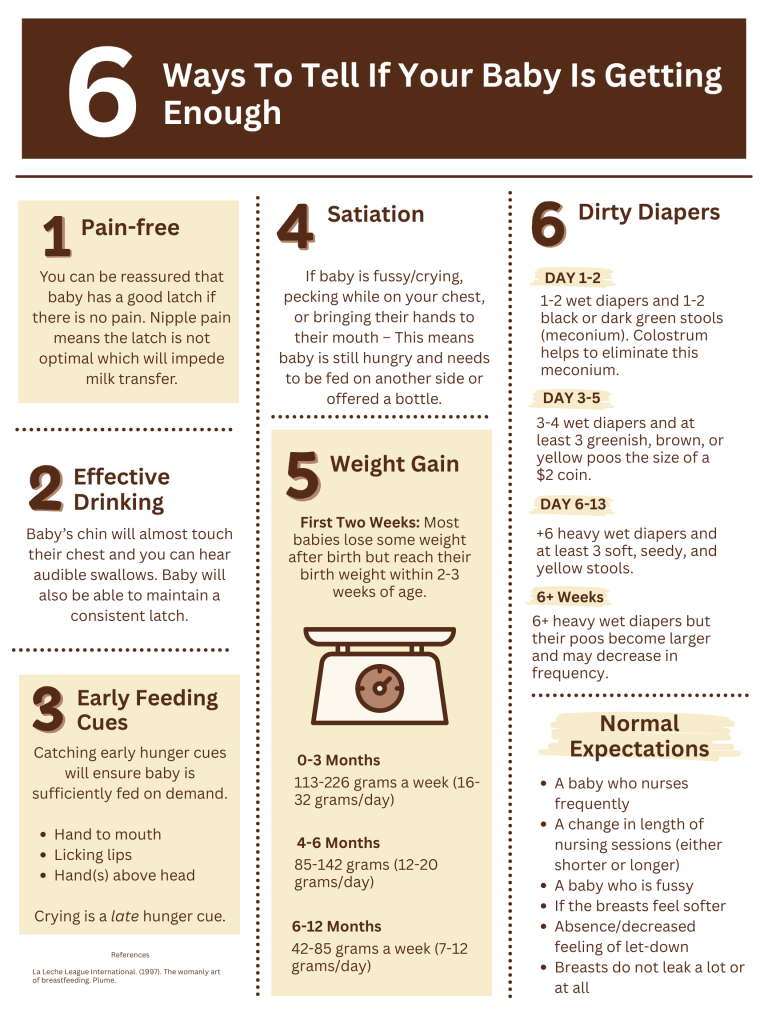
You can follow the handout below or print it for yourself!
 Peace Of Motherhood
Leave a comment