Before understanding how an epidural and Pitocin can affect labour, one must first understand how this purposeful, intentional, intricate design is meant to work without them. If you haven’t already read my blog, “Physiological Birth,” go ahead and do that before continuing!
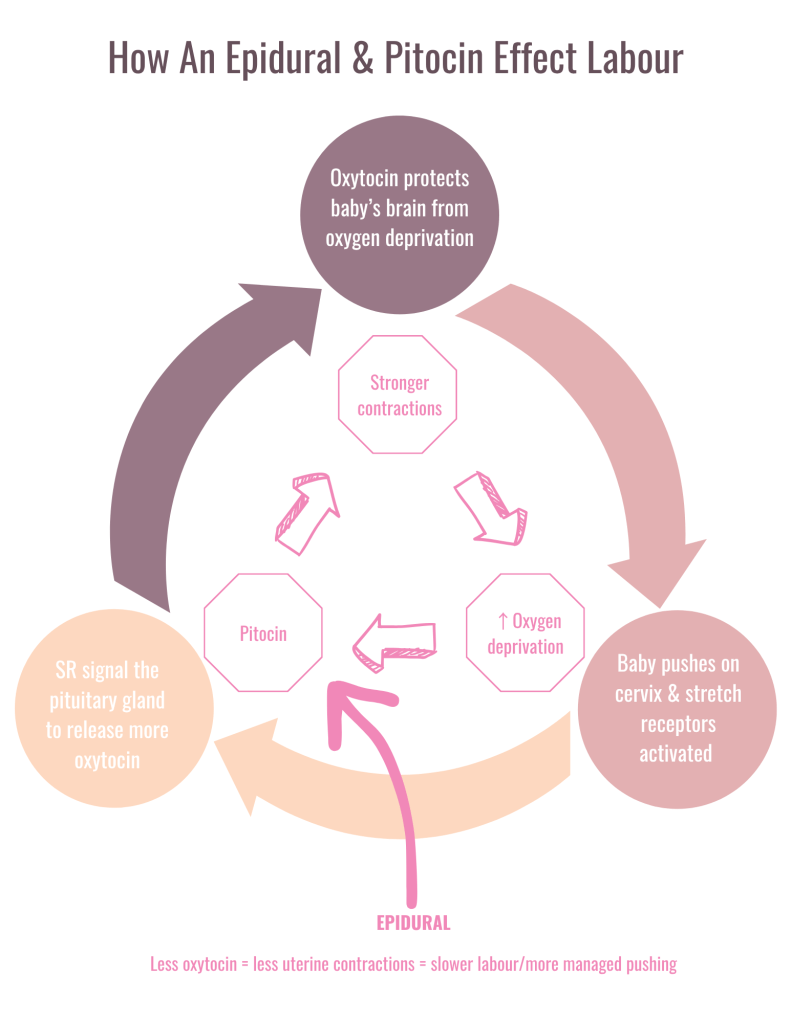
An epidural stops the pain signal of the stretch receptors from reaching the brain. The brain doesn’t send the signal to release more oxytocin. Without oxytocin, contractions slow down and labour stalls. Epidurals inhibit the mother from being able to move in an upright position which helps shift baby further into the pelvis. The baby also stops receiving the inhibitory signal to decrease brain activity which results in a decrease of brain protection.
If labour slows/stalls, pitocin is administered. Pitocin speeds up contractions but can easily become too frequent and too strong which can exhaust the uterus (but you think it’s fine because you can’t feel anything!) Unnatural, persistent, and strong contractions along with a decrease in the brain protection can send a baby into distress very quickly leading to emergencies.
Pitocin, which is often used in inductions and alongside the use of an epidural, can interfere with the natural physiological process of coping in labour. If labour isn’t progressing, Pitocin makes the uterus contract but does not have the same ability to produce those joyful and pleasurable feelings. So pain will be more intense and not as easily managed.
Epidurals and Pitocin will disrupt the hormonal balance in labour which is why once one intervention is introduced, it is a slippery slope for further interventions. Keeping both medications to a minimum and attempting to encourage natural oxytocin will help keep you and your baby safe!
When Epidurals + Pitocin are really needed:
If a woman is in labour for many hours and has been given all the comfort possible from the environment around, yet she is unable to progress, she may be a good candidate to consider such interventions. A low dose epidural can help take the edge off the pain of the contractions and allow the birthing woman to get the necessary rest she and her uterus both need. After some rest, the uterus may feel stronger to be more effective and the birthing mother will have a boost of energy to continue labour. The epidural can also be turned off or kept low to continue labour once the mother has had some rest.
Pitocin may also be needed in the case where contractions are not effective and the mother is becoming tired. Ensuring the mother is not fully numb for the duration of the entire labour and Pitocin is administered sparingly to not exhaust an over worked uterus, this can help maintain the safest space possible for both mother and baby.
 Peace Of Motherhood
Leave a comment