Physiological birth, or natural childbirth, emphasizes a gentle, supportive process with minimal interventions, relying on the body’s innate ability to labor and give birth. It is a complex hormonal process that works seamlessly, without interruption. So let’s dive into one of the major hormones at play when we let labour resolve on its own.
Oxytocin
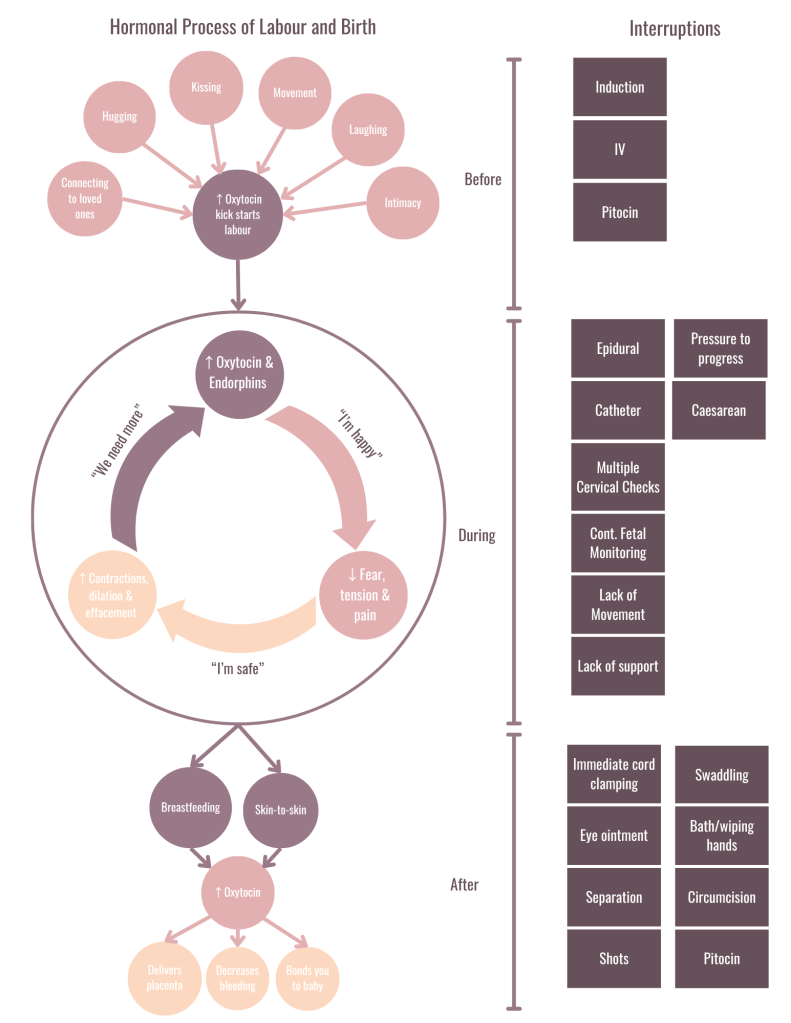
Oxytocin is often referred to as the “love hormone” because it is released when we feel connected to someone (Welton, 2014). However, I like to call it the “Miracle Hormone” in light of the numerous roles it assumes in labour, birth, and postpartum. Oxytocin stimulates uterine contractions, helps with pain management during labour, provides protection for baby’s brain against hypoxia (lack of oxygen) during contractions, encourages the delivery of the placenta, decreases hemorrhaging after birth, and stimulates milk ejection while breastfeeding. Labour is initiated by oxytocin, maintained with oxytocin, and oxytocin plays a crucial role immediately after birth. You can reference the picture down below to follow along.
How to release oxytocin to initiate labour:
An increase of oxytocin near the end of pregnancy by hugging, kissing, being intimate, or connecting with loved ones can stimulate uterine contractions to begin.
How to release oxytocin during labour:
As stated, oxytocin is what tells the uterus to contract. The more oxytocin, the faster labour progresses. A labour that stalls is one subjected to interventions to help move the process along. If you feel your labour has stalled, try holding onto someone you love, looking at pictures of your other children or wedding pictures. Increasing oxytocin can help the contractions start once again. Something else to keep in mind is to ensure there is no one in the room who is making you feel tense, scared, or uncomfortable. These feelings inhibit oxytocin release.
Roles oxytocin has in labor and birth:
There are many ways to stimulate oxytocin release during labour and many ways are more effective in the presence of a loved one. When a woman is loved, held, comforted, made to feel safe and protected, she produces oxytocin. It is also released while laughing, kissing, hugging, praying, listening to music, being intimate, and much more. If it makes her feel happy and safe, it releases oxytocin! This hormone can offset the signals of pain in labour because of its euphoric abilities.
Once labour begins, the oxytocin allow the birthing woman to feel good, happy, and safe. If a woman feels these things her cervix can dilate, soften and thin out (effacement). Both necessary in order for the baby to exist the birth canal. The more a woman feels safe, the more oxytocin is released. The more oxytocin that is released, the stronger the contractions will be.
The same is true for animals in the wild. As cats and other animals will naturally find a quiet, dark place of solitude where they can labour safely with no interruptions, so should a woman create the same environment for herself. Hospitals with multiple providers coming in and out, bright lights, and cervical checks often impede this ability to create such a space.
As oxytocin stimulates more uterine contractions, it pushes the baby’s head onto the pelvic floor and cervix activating the stretch receptors in those structures. When the stretch receptors are activated, this sends a signal to the brain to release MORE oxytocin, thus contributing to a progressive labour. As labour progresses, contractions become more intense for both mother and baby.
Short intervals of low oxygen levels are due to the constricting of the uterine muscle. Oxytocin decreases brain cell activity in the baby. Brain activity requires oxygen for neural transmission. If there is less brain cell activity, then less oxygen is needed. This mechanism is to protect the baby’s brain from the falling oxygen levels during contractions.
When the baby emerges, the mother is meant to hold her baby for the first two hours and establish her first breastfeed before removing the baby to be weighed or examined. This initial bonding is crucial as it continues to stimulate oxytocin from holding and kissing the new baby. Oxytocin continues the uterine contractions to help the uterus return to its normal size. This effective contracting of the uterus helps decrease hemorrhaging as the wound from the placenta rapidly decreases in size.
Furthermore, this uninterrupted process after birth will provide the most optimal environment for baby to crawl along his/her mother’s abdomen, find the nipple, and latch on. This is an instinctive process that should not be disturbed so the mother has a smooth transition into breastfeeding. Oxytocin which is increased from the suckling at the breast then helps move milk from the breast ducts to the nipple. More skin-to-skin contact and suckling means faster milk let-down which leads to an easier transition to breastfeeding.
How to release oxytocin immediately after birth:
Ways to increase oxytocin after birth can simply be by holding your baby, looking at your baby, kissing your baby, having skin-to-skin contact, and breastfeeding. If you feel you “don’t have milk,” these suggestions as well as looking through photos of your wedding or your first date with your partner. This will be sure to boost your mood and oxytocin levels which will help get your milk flowing!
Endorphins
A hormone that relieves pain, reduces stress, improves mood, and increases feelings of well-being. This hormone works by blocking pain receptors in the brain, meaning you’re likely to feel less pain the more endorphins you release.
As oxytocin increases, it stimulates the release of endorphins. These hormones work hand in hand. Endorphins are happy and pleasurable hormones and they act as a natural pain blocker (Welton, 2014). When the body feels pain, the pain signal travels along the neuron from cell to cell making its way to the brain. However, when endorphins are released they connect to the transmission site and block the signal from reaching the brain. If the signal doesn’t reach the brain, the stimulus is not felt. When a woman thinks positively about what she is experiencing and feels safe to allow her body to progress, she will release more endorphins. The endorphins will block more of these sites and she will feel less pain.
How to release endorphins during labor:
You can release endorphins by saying words of affirmation, maintaining movement, singing, praying, laughing, and being supported by someone you love. Very similar to how to release oxytocin, but there is more of an emphasis on movement and vocalizations. When these hormones are released, you are relaxed and can naturally allow your body the freedom to move through labour. On the contrary, tension and fear prevent your body from doing what it needs to do. Your thoughts have the power to change the outcome of what you feel in the physical body.
 Peace Of Motherhood
Leave a comment